The Story
Long before I understood concepts like inclusion or Living Possibility, there was a little girl who quietly changed the way I saw the world.
Her name wasn't really Petal.
That's just what I called her.
She reminded me of a tiny wildflower.
Every afternoon she seemed to return from the playground with something tangled in her hair. A leaf. A blade of grass. A tiny twig. Sometimes a flower petal. She loved wandering through the school gardens, collecting little treasures without even meaning to.
The more overwhelmed she was, the wilder her hair became.
At the beginning of the year, I didn't realise that.
I just knew she looked exactly like the nickname I'd given her.
Petal.
She was tiny, impossibly skinny and almost always preferred bare feet if she could get away with it. She hated being hot. After lunch she usually had a little Vegemite moustache across her face. If my lunch looked more appealing than hers, she'd happily help herself without asking.
She was wonderfully, unapologetically herself.
Like many children with complex communication needs, Petal didn't always have the words to explain what she needed.
Sometimes she growled.
Sometimes she screamed.
Sometimes she simply walked away.
To someone who didn't know her, it could look like defiance.
But the more time I spent with her, the more I realised her behaviour was rarely random.
It was communication.
One afternoon after lunch, the bell rang for everyone to head back to class.
By the time I reached the playground, almost all of the students had already gone inside.
Petal was still outside.
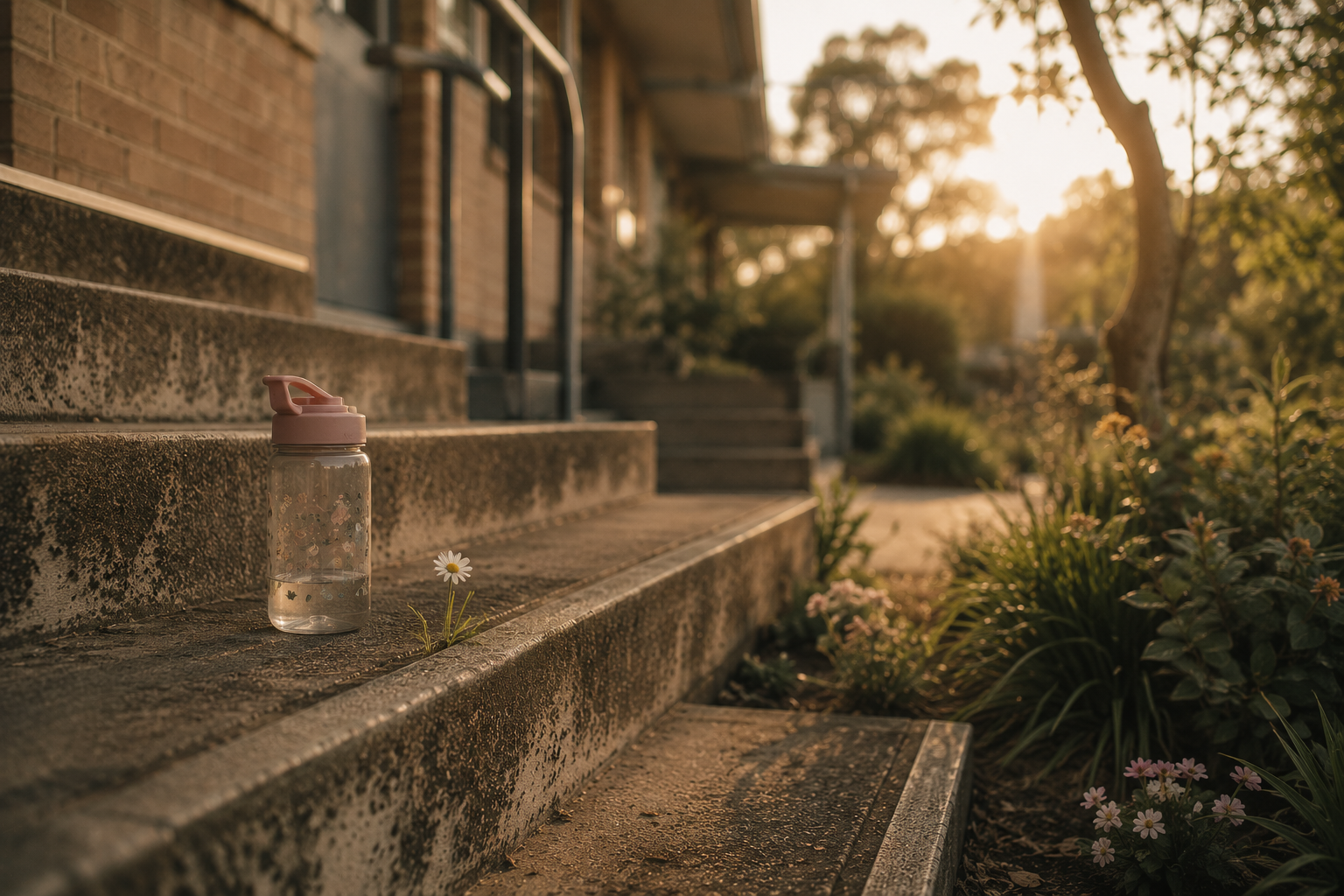
She was lying on the concrete steps in the shade.
An SLSO had already tried to encourage her back to class.
She refused.
Grunting.
Screaming.
Staying exactly where she was.
Everyone's focus was on getting her to move.
I remember walking over to her.
I didn't ask her to stand up.
I didn't tell her it was time for class.
I simply sat down beside her.
I put my bag next to me.
I placed my water bottle on the ground.
Then we sat together.
For a little while, nothing happened.
Then, without a word, Petal reached over, grabbed my water bottle and drank.
She drank as though she'd never had water before.
Long, uninterrupted mouthfuls.
When she finished, she quietly placed the bottle back on the ground.
Then she rested her head against my leg.
She sighed.
And she relaxed.
We stayed there together for a little longer.
There was no rush.
No negotiation.
No reward.
Just two people sharing a quiet moment.
Eventually, I held out my hand.
She took it.
Together we walked back to our cool, air-conditioned classroom.
It looked so simple.
Almost ordinary.
Later, people joked that I'd lost my water bottle.
Others laughed that I must have had some kind of magic touch because Petal had walked back to class without another sound.
But there wasn't any magic.
I was simply beginning to understand her.
Over the months that followed, our relationship continued to grow.
She began trusting me in ways that couldn't be measured on a report or a checklist.
She let me gently brush the leaves, petals and twigs from her hair.
She allowed me into her world.
As the year went on, she became calmer.
More confident.
She could participate in whole-class lessons.
She attended assemblies.
She joined excursions without becoming overwhelmed.
She still loved the gardens.
She still preferred bare feet whenever she could.
She still occasionally wore a Vegemite moustache after lunch.
She was still unmistakably Petal.
But she had grown.
Not because we had forced her to change.
Because together we had learnt what she needed to thrive.
What I Noticed
Looking back, I've realised this story was never really about a water bottle.
It wasn't even about getting a little girl back to class.
It was about what happens when we stop asking, "How do I get this person to do what I need?" and start asking, "What might they be trying to tell me?"
Everyone else that afternoon was trying to solve the problem they could see.
A child refusing to move.
I wasn't trying to solve the problem.
I was trying to understand the person.
That small shift changed everything.
People often ask what strategy I used with Petal.
The truth is, there wasn't one.
There was curiosity.
There was patience.
There was trust.
The staircase wasn't the moment I earned Petal's trust.
It was the moment her trust became visible.
I've continued to notice the same pattern throughout my career.
In schools.
In leadership.
In workplaces.
The people we describe as "challenging" are often carrying information we haven't learnt how to read yet.
When we become curious enough to understand the person before trying to change the behaviour, entirely new possibilities begin to emerge.
Sometimes people don't need us to have the perfect strategy.
Sometimes they simply need us to sit beside them long enough to understand what they're experiencing.
Reflection
- When was the last time you paused to understand someone before trying to change them?
- What behaviour in your workplace might actually be communicating an unmet need?
- What becomes possible when curiosity replaces urgency?
Related Principle
Behaviour provides information.
People rarely struggle in isolation.
They respond to the conditions around them.
When we choose curiosity over judgement, we create the conditions for trust, connection and possibility to grow.
Sometimes the greatest changes begin when we stop trying to make someone move and simply choose to sit beside them.

The little girl who taught me to notice